Hardened Hearts & Holy Warnings
What happens when a people refuse to bow their necks but insist on lifting their chins? How long can a culture ignore divine warnings before the echoes turn into earthquakes? Is it possible that judgment is not sudden fury, but delayed mercy finally exhausted? And what if the greatest danger to faith is not ignorance, but stubborn familiarity with God’s voice?
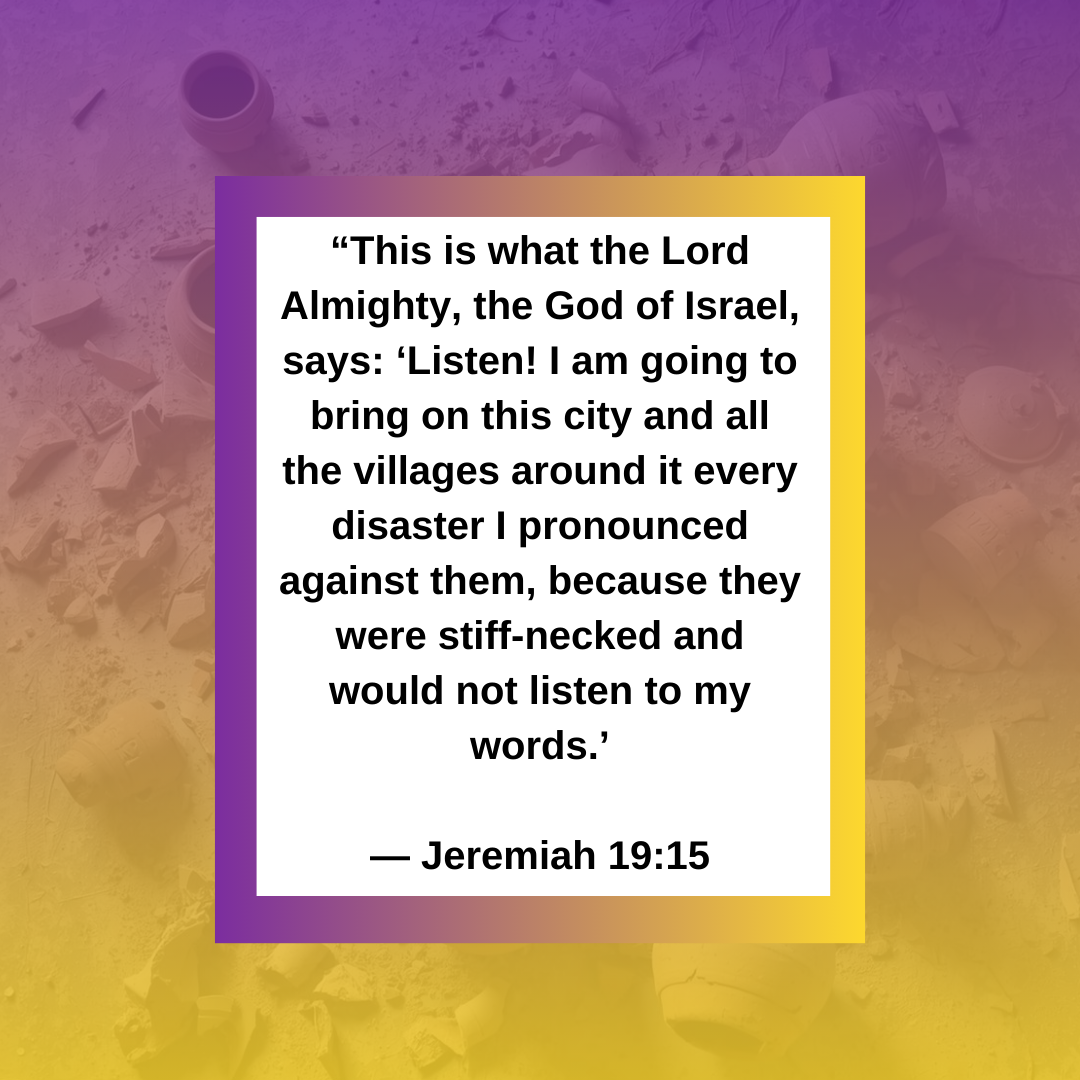
Jeremiah 19 confronts us with a scene so piercing, so uncomfortable, that many modern readers wish it were not in Scripture at all. It is a prophetic drama staged in a valley soaked with blood, idolatry, and the cries of the innocent. It is a sermon preached not merely with words, but with a clay jar smashed against stone. This chapter is not gentle. It does not whisper. It shouts, shatters, and stings the ears of those who hear it. Yet beneath its severity pulses a holy ache, the grief of a God whose people would not listen. The passage peaks in verse 15, where the Lord names the root of the catastrophe, “because they were stiff-necked and would not listen to my words.” This is not just bible history alone. It is a mirror held up to every generation that confuses freedom with defiance and tolerance with truthlessness.
The Potter’s Purchase and the Prophetic Performance
The chapter opens with God commanding Jeremiah to buy a clay jar from a potter and to gather elders and priests as witnesses. This is already significant. The leaders, the influencers, the respected voices are summoned not to a strategy meeting, but to a symbolic act of judgment. God sends them outside the city, away from the temple’s comforting rituals, into the Valley of Ben Hinnom, a place already infamous for child sacrifice and pagan worship. The location matters because sin always leaves a geography. Rebellion stains places as well as people. God forces His message into the very soil where their compromise had taken root.
Jeremiah proclaims a word that makes ears tingle. The Hebrew phrase suggests a ringing shock, a stunned horror. This is not sensationalism; it is revelation. God announces disaster not because He delights in destruction, but because the people have forsaken Him. They replaced the living God with foreign gods, burned incense to what they did not know, and shed innocent blood. Idolatry and injustice are always twins. When worship is corrupted, ethics soon follow. The Valley of Ben Hinnom becomes a courtroom, and the evidence is overwhelming.
Forsaken Faith and Familiar Falsehoods
What makes this passage especially sobering is that Judah’s sins were not committed in ignorance. Verse 4 underscores that they worshiped gods neither they nor their ancestors knew. This was willful novelty, spiritual experimentation masquerading as progress. God explicitly states that child sacrifice “did not enter my mind,” dismantling any attempt to baptize cruelty with religious language. Culture had drifted so far that evil was normalized and even ritualized.
Our modern world bristles at such ancient barbarity, yet we must ask whether we are truly more enlightened or merely more sophisticated in our idolatry. We may not burn children on altars of Baal, but we do sacrifice innocence on the altars of convenience, pleasure, and profit. We baptize greed as success, lust as self-expression, and pride as authenticity. Like Judah, we often forsake God not by denying Him outright, but by sidelining Him, keeping Him as a symbol while enthroning substitutes that better suit our desires.
The Shattering Sign and the Severity of Sin
God then instructs Jeremiah to break the jar in front of the witnesses. The act is irreversible. A smashed clay vessel cannot be reassembled into its original form. The message is chillingly clear: there comes a point where consequences cannot be undone. This does not negate God’s mercy; it reveals the cost of rejecting it. Judgment here is not arbitrary. It is the logical end of persistent rebellion.
The imagery confronts a theology that assumes endless second chances without repentance. God is patient, but patience is not permissiveness. The smashed jar declares that nations, like vessels, have a purpose, and when that purpose is consistently defied, fracture follows. Jerusalem would become like Topheth, a place of horror and scorn, not because God abandoned them first, but because they abandoned Him repeatedly.
Stiff-Necked Spirits and Stubborn Souls
Verse 15 is the theological key that unlocks the chapter’s meaning. God names the disease behind the disaster, stiff-necked resistance. The phrase evokes an ox that refuses the yoke, a creature so rigid that it cannot be guided. This is not ignorance; it is defiance. They heard the words, but they would not listen. Hearing without heeding is one of Scripture’s most dangerous diagnoses.
A stiff neck is a posture problem. It is the refusal to bow. Biblically, repentance always involves a yielding, a turning, a humbling of the self before God. Stiff-necked people may be religious, but they are unrepentant. They may quote Scripture, but they resist correction. They prefer affirmation over admonition, comfort over conviction. Judah’s tragedy was not lack of revelation, but lack of response.
Cultural Echoes and Contemporary Convictions
Our generation is not immune to stiff-necked spirituality. We live in a culture that prizes autonomy above accountability and feelings above faithfulness. God’s Word is often filtered through personal preference, trimmed to fit ideological comfort. When Scripture confronts us, we are tempted to label it outdated, offensive, or irrelevant. Yet the refusal to listen does not silence God; it simply amplifies the consequences.
The church itself must tremble at this text. Judgment in Jeremiah 19 begins with leaders, elders, and priests standing in the valley. Accountability always starts at the house of God. When pulpits soften truth to appease culture, when repentance is replaced with positive thinking, and when holiness is mocked as legalism, stiff necks multiply. God’s warnings still tingle ears, but many scroll past them, anesthetized by distraction.
Repentance Remembered and Redemption Revealed
Yet even in this severe chapter, repentance hovers like an unspoken invitation. God warns because He desires to be heard. The prophetic act is meant to provoke change, not merely announce doom. Throughout Scripture, judgment is God’s strange work; mercy is His delight. The very fact that Jeremiah speaks is evidence that it is not too late, though the window is narrowing.
Repentance is not mere regret. It is a reorientation of the neck and heart. It is the willingness to bow, to listen, to obey. The gospel later reveals what Jeremiah could only foreshadow: that God Himself would be shattered, broken not in judgment against sinners, but in sacrifice for them. Christ bore the smashing we deserved so that repentant hearts could be reshaped.
From Shattered Warning to Softened Will
Jeremiah 19 stands as a warning etched in clay and blood, but it also stands as a mercy. It tells us that God takes sin seriously because He takes people seriously. He confronts because He cares. Verse 15 lingers like a divine diagnosis spoken with grief, not glee. “They were stiff-necked and would not listen.” May that never be said of us.
In an age allergic to repentance, this chapter calls us to recover the courage to bow. To listen. To turn. The potter still shapes willing clay. But the warning remains, stiff necks eventually meet shattered vessels. Blessed are those who hear while there is still time, who repent while the jar is still whole, and who choose humility before the smash.