Remnant, Rising & Remaining
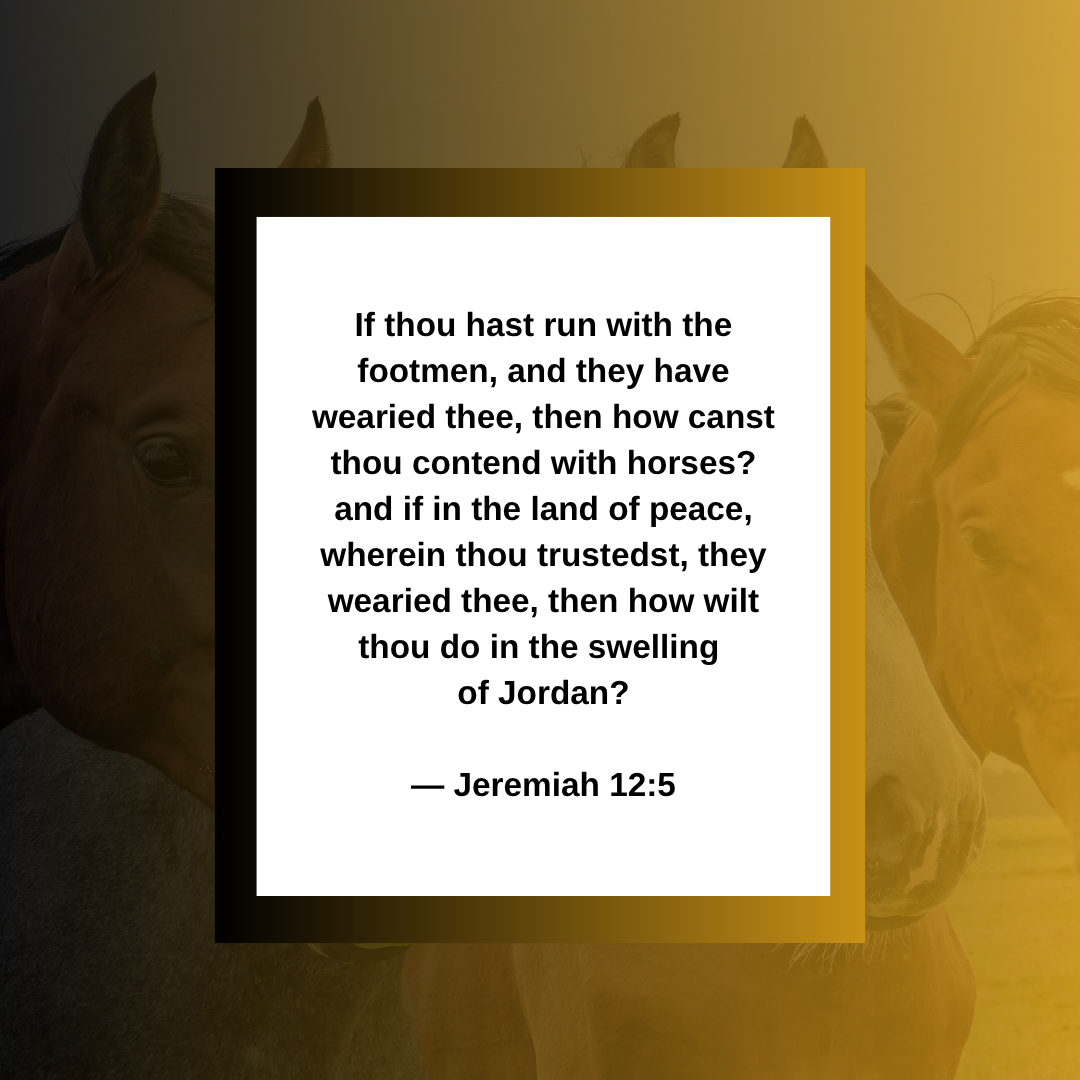
“If thou hast run with the footmen, and they have wearied thee, then how canst thou contend with horses? and if in the land of peace, wherein thou trustedst, they wearied thee, then how wilt thou do in the swelling of Jordan?” - Jeremiah 12:5
WHEN PRESSURE PRESSES HARD
What happens when life becomes harder than anyone expected? What happens when prayers seem unanswered, the culture becomes increasingly hostile, economic uncertainty presses against the household, and even faithful people begin wondering how much more they can take?
Jeremiah 12:5 answers with a question that still rattles the soul, If the footmen have already worn you out, how will you contend with horses? It is a startling question, but it is not designed to crush Jeremiah. It is designed to prepare him. Sometimes the struggle that feels like the end is actually training for what comes next.
A PROPHET UNDER PRESSURE
Jeremiah was a prophet of Judah whose ministry unfolded during one of the darkest periods in the nation's history. He was called by God while still young and sent to speak difficult truths to a people who had drifted deeply from covenant faithfulness. Jeremiah did not have the luxury of delivering popular messages. He warned Judah that spiritual rebellion had consequences. Idolatry, injustice, false worship and misplaced trust were leading the nation toward catastrophe. His assignment was not easy. He was sent to confront spiritual rebellion. His message was often rejected, and his faithfulness brought opposition from powerful people and even those from his own hometown.
His preaching placed him in conflict with kings, priests, prophets and powerful people. Yet Jeremiah kept speaking. That is part of what makes his book so important. Jeremiah is not a story about a prophet who never became discouraged. It is a story about a prophet who became discouraged and kept obeying God. That is what makes his story so powerful. A person can love God, trust God and still bring difficult questions before Him.
RELIGIOUS RITUALS, REAL REPENTANCE
The Book of Jeremiah remains important because it exposes the difference between religious appearance and spiritual transformation. Judah had a temple, religious traditions and a national identity connected to God. Yet Jeremiah warned that outward religion could never replace inward obedience.
That warning still reaches the heart. Religious language, traditions and appearances cannot substitute for a life surrendered to God. Jeremiah's message is ultimately about the heart, because God is not merely looking for people who appear faithful. He is calling people to actually walk faithfully. A society can possess churches, Bibles, religious language and public expressions of faith while individuals still need repentance, justice, mercy and renewed devotion to God.
Jeremiah also reveals something deeply personal about walking with God. The prophet struggles. He complains. He asks why wicked people seem to prosper. He wonders why those who oppose him appear to flourish. Yet God does not abandon him because he asks difficult questions. Instead, God teaches him.
That makes Jeremiah a book for anyone attempting to remain faithful while living through confusing circumstances.
BEFORE THE HORSES, THE FOOTMEN
By chapter 12, Jeremiah has already endured rejection, opposition and threats. He has watched wicked people appear to prosper while those seeking to follow God suffer. So he brings his complaint before the Lord.
Then God answers with the image of the footmen and the horses. The footmen represent one level of difficulty. The horses represent something greater. The peaceful land represents relative stability, while the swelling Jordan represents circumstances that can become dangerous, unpredictable and overwhelming. God is not promising Jeremiah an easier road. God is preparing him for a harder one.
Spiritual strength is learning where to stand when pressure arrives.
FAITH IN A FRAGILE WORLD
That message still speaks to a world filled with relentless noise. Political division can exhaust the mind. Economic uncertainty can pressure the household. Social media can turn every disagreement into an emotional emergency. News can arrive faster than the heart can process it. The temptation is to believe that peace means the absence of problems.
Jeremiah 12:5 points to something deeper. Spiritual strength is learning where to stand when pressure arrives. Political institutions matter. Economic realities matter. Wise decisions matter. But none of them can become the foundation of the soul. Jeremiah lived through political instability and national crisis, yet his ultimate assignment remained faithfulness to God. The same principle applies when financial pressure arrives. A paycheck matters. A household budget matters. Economic stability matters. But the believer's ultimate security cannot rest in a market, a government, an account balance or a forecast.
THE QUESTION BEHIND THE QUESTION
The question is not simply, “How can someone survive this?” The deeper question is, “What is God developing through this?” Perhaps the footmen are not the final test. Perhaps they are preparation.
The frustration, disappointment, uncertainty and resistance of today can become training for the responsibility of tomorrow. The believer does not have to waste the struggle. Adversity can deepen prayer. Uncertainty can expose misplaced trust. Disappointment can produce endurance. The difficulty may be real, but it does not have to be wasted.
WHEN THE STORM STARTS SWELLING
Jeremiah 12:5 challenges the assumption that faith means escaping every difficult circumstance. Sometimes faith means becoming strong enough to remain faithful while walking through the circumstance. The footmen may represent today's frustration. The horses may represent tomorrow's responsibility. The swelling Jordan may represent the moment when circumstances appear too large to control.
Yet God is still present. That means the believer can face political uncertainty without surrendering to fear, face economic uncertainty without surrendering to despair, and face spiritual opposition without surrendering faith. The storm may be loud. But God is not silent.
Jeremiah reminds the believer that political institutions are not the ultimate foundation of hope. Government has responsibilities. Citizens have responsibilities. Leaders have responsibilities. But God remains God regardless of who holds power.
Jeremiah lived through political instability, corrupt leadership and national crisis. His answer was not political escapism. It was faithfulness. Economic anxiety can feel like a race against horses. Global economic conditions remain subject to inflation, geopolitical conflict, financial instability and changing growth expectations. For ordinary people, however, economic pressure is rarely an abstract statistic. It can mean difficult decisions. It can mean delayed dreams. It can mean uncertainty about the future.
Jeremiah 12:5 does not promise financial ease. It points toward something deeper, endurance. The believer's security ultimately cannot rest on a paycheck, a market, a government program, a retirement account or a particular economic forecast. Those things matter, and wise stewardship matters. But none of them can carry the weight of the human soul.
Yet God is still present.
WHEN EAGLES ELEVATE
Jeremiah 12:5 challenges the assumption that the goal of faith is to escape every difficult circumstance. Sometimes the deeper question is whether the person facing the circumstance is becoming spiritually stronger.
The footmen may be today's frustration. The horses may be tomorrow's responsibility. The swelling Jordan may represent circumstances that appear impossible to control. And yet God is already asking Jeremiah to think beyond the present moment.
There is one final picture worth remembering. A horse can run, but an eagle can rise. The horse moves across the ground and battles the terrain. The eagle catches the wind and rises above it. The Christian life is not ultimately a contest of human willpower. Strength comes from dependence upon God. That is why Isaiah 40:31 belongs beside Jeremiah 12:5: “But they that wait upon the LORD shall renew their strength; they shall mount up with wings as eagles; they shall run, and not be weary; and they shall walk, and not faint.”
That is the hope. The eagle does not beat the horse by running harder on the horse's terms. It rises. When the footmen have worn someone out, the story is not over. When the horses come, God is still God. When the Jordan swells, the Lord has not disappeared. When the storm intensifies, faith still has somewhere to stand. The footmen are not the final story. The horses are not the final story. The storm does not have the final word. Be encouraged. The God who called Jeremiah through the storm is still able to strengthen us through ours.