Principalities, Powers & Patterns
What if the battles shaping nations, cities, and empires were not fought only on streets or in courts but in unseen realms? Scripture reveals that spiritual forces principalities, powers, and territorial strongholds move behind the scenes, steering governments, economies, and cultures. From Persia to Rome, from Ephesus to Canaan, the Bible exposes these invisible rulers, not as objects of fear, but as realities to understand, resist, and expose through truth. Their influence is vast, their pride palpable, yet their power is finite under the sovereign hand of God. Are we blind to the systems shaping our world, or will we rise to discern the spiritual architecture behind history itself?
For we wrestle not against flesh and blood, but against principalities, against powers, against the rulers of the darkness of this world, against spiritual wickedness in high places. -Ephesians 6:12
Below are clear biblical examples of principalities operating over regions, with the relevant Scripture in the Word of God. These examples show territorial influence, not superstition, and always remain under God’s sovereignty.
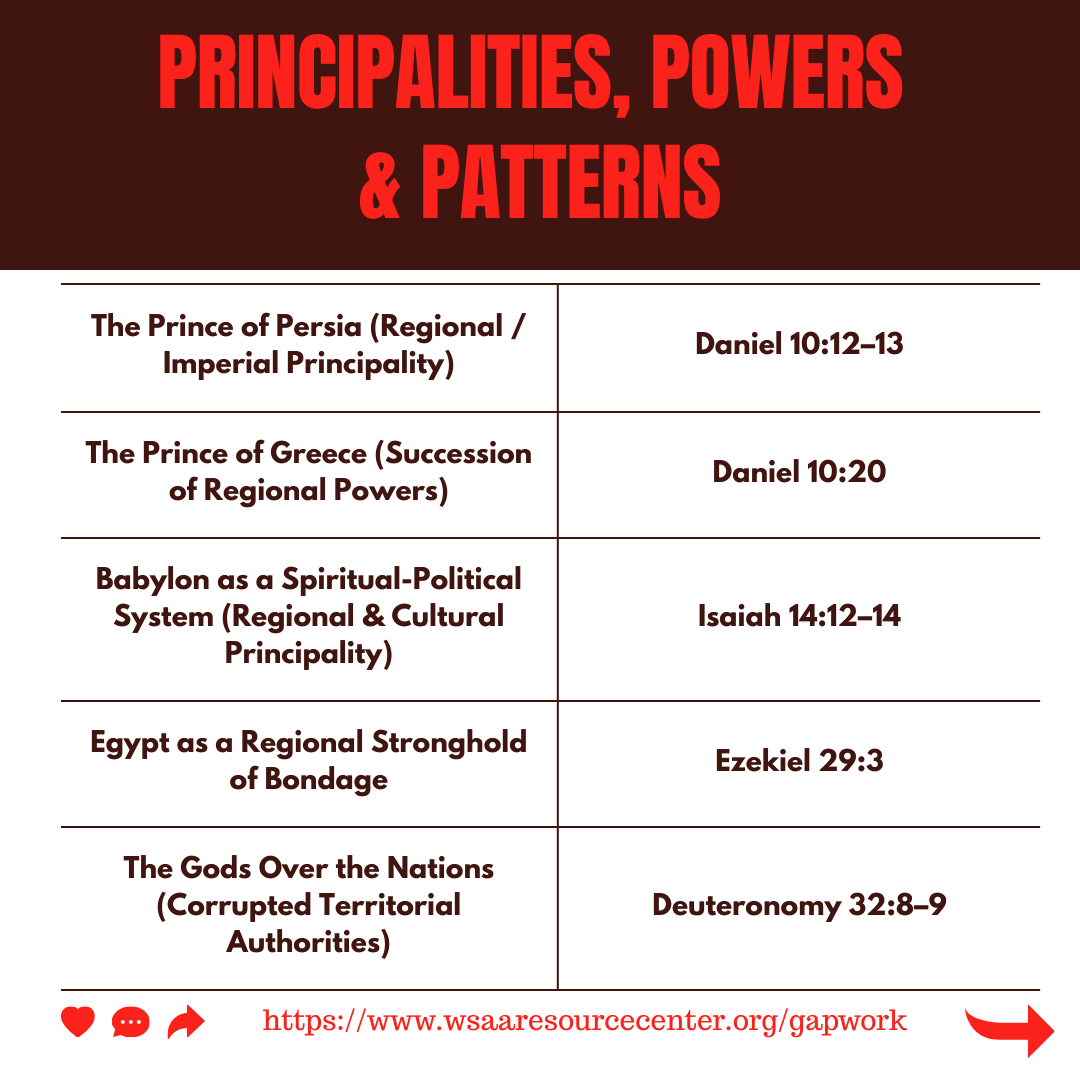
1. The Prince of Persia (Regional / Imperial Principality)
Daniel 10:12–13
“Then said he unto me, Fear not, Daniel: for from the first day that thou didst set thine heart to understand, and to chasten thyself before thy God, thy words were heard, and I am come for thy words.
But the prince of the kingdom of Persia withstood me one and twenty days: but, lo, Michael, one of the chief princes, came to help me; and I remained there with the kings of Persia.”
This passage explicitly reveals a spiritual ruler assigned to the Persian Empire, resisting God’s messenger. The conflict is regional and governmental, not personal, showing that political powers were being influenced by spiritual authorities.
2. The Prince of Greece (Succession of Regional Powers)
Daniel 10:20
“Then said he, Knowest thou wherefore I come unto thee? and now will I return to fight with the prince of Persia: and when I am gone forth, lo, the prince of Grecia shall come.”
This shows successive territorial principalities, aligned with rising empires. As earthly dominance shifted from Persia to Greece, the spiritual authority influencing the region also shifted, confirming regional spiritual governance.
3. Babylon as a Spiritual-Political System (Regional & Cultural Principality)
Isaiah 14:12–14
“How art thou fallen from heaven, O Lucifer, son of the morning! how art thou cut down to the ground, which didst weaken the nations! For thou hast said in thine heart, I will ascend into heaven, I will exalt my throne above the stars of God: I will sit also upon the mount of the congregation, in the sides of the north:
I will ascend above the heights of the clouds; I will be like the most High.”
While addressed to the king of Babylon, the language clearly transcends a human ruler. Babylon represents a regional principality of pride, domination, and self-exaltation influencing nations through culture, power, and ideology.
4. Egypt as a Regional Stronghold of Bondage
Ezekiel 29:3
“Speak, and say, Thus saith the Lord GOD; Behold, I am against thee, Pharaoh king of Egypt, the great dragon that lieth in the midst of his rivers, which hath said, My river is mine own, and I have made it for myself.”
The imagery of Pharaoh as a dragon reveals a spiritual power behind Egypt’s regional identity oppression, false ownership, and resistance to God’s freedom. Egypt becomes a biblical symbol of territorial bondage.
5. The Gods Over the Nations (Corrupted Territorial Authorities)
Deuteronomy 32:8–9
“When the Most High divided to the nations their inheritance, when he separated the sons of Adam, he set the bounds of the people according to the number of the children of Israel.
For the LORD’S portion is his people; Jacob is the lot of his inheritance.”
(Note: Older textual traditions reflect spiritual oversight of nations, later rebuked in Psalm 82.)
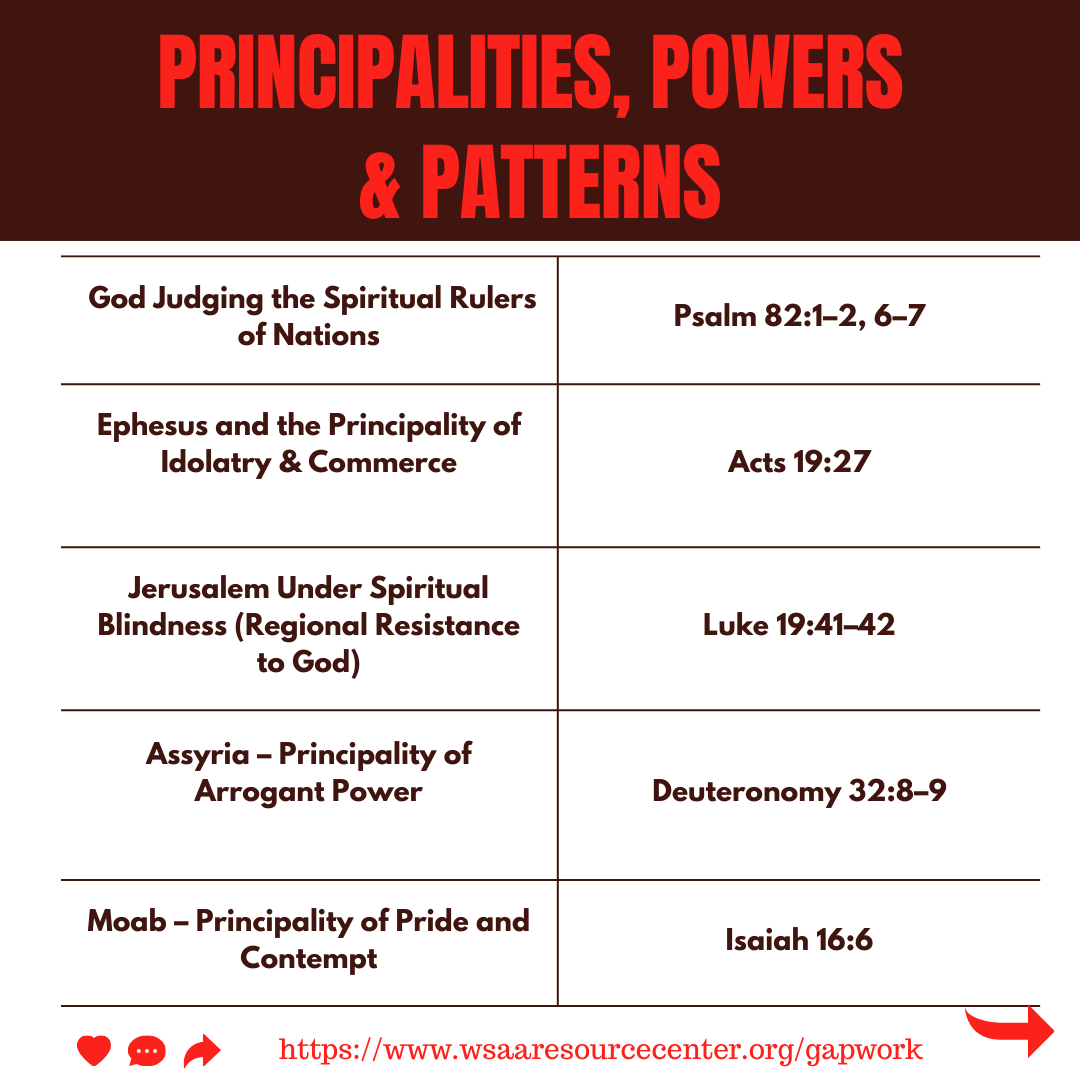
6. God Judging the Spiritual Rulers of Nations
Psalm 82:1–2, 6–7
“God standeth in the congregation of the mighty; he judgeth among the gods.
How long will ye judge unjustly, and accept the persons of the wicked? Selah.I have said, Ye are gods; and all of you are children of the most High.
But ye shall die like men, and fall like one of the princes.”
These “gods” are spiritual authorities assigned over nations, rebuked for injustice. God holds them accountable for how regions are governed spiritually and morally.
7. Ephesus and the Principality of Idolatry & Commerce
Acts 19:27
“So that not only this our craft is in danger to be set at nought; but also that the temple of the great goddess Diana should be despised, and her magnificence should be destroyed, whom all Asia and the world worshippeth.”
Ephesus was dominated by a regional principality tied to religion, economy, and identity. When the gospel advanced, the entire city reacted not just individuals showing territorial influence.
8. Jerusalem Under Spiritual Blindness (Regional Resistance to God)
Luke 19:41–42
“And when he was come near, he beheld the city, and wept over it,
Saying, If thou hadst known, even thou, at least in this thy day, the things which belong unto thy peace! but now they are hid from thine eyes.”
Jerusalem’s resistance was not ignorance but spiritual blindness over a region, despite Scripture, prophets, and Messiah present. Jesus responds not with warfare language but with grief and truth.
9. Assyria – Principality of Arrogant Power
Isaiah 10:12–13
“Wherefore it shall come to pass, that when the Lord hath performed his whole work upon mount Zion and on Jerusalem, I will punish the fruit of the stout heart of the king of Assyria, and the glory of his high looks.
For he saith, By the strength of my hand I have done it, and by my wisdom; for I am prudent: and I have removed the bounds of the people, and have robbed their treasures, and I have put down the inhabitants like a valiant man.”
Assyria is portrayed as an instrument used by God, yet animated by a spirit of pride and domination. The arrogance exceeds the human king, revealing a principality influencing imperial conquest and self-exaltation.
10. Moab – Principality of Pride and Contempt
Isaiah 16:6
“We have heard of the pride of Moab; he is very proud: even of his haughtiness, and his pride, and his wrath: but his lies shall not be so.”
Moab is judged not merely for actions but for a regional spiritual identity of pride and hostility toward God’s people, showing how collective character reflects deeper spiritual influence.
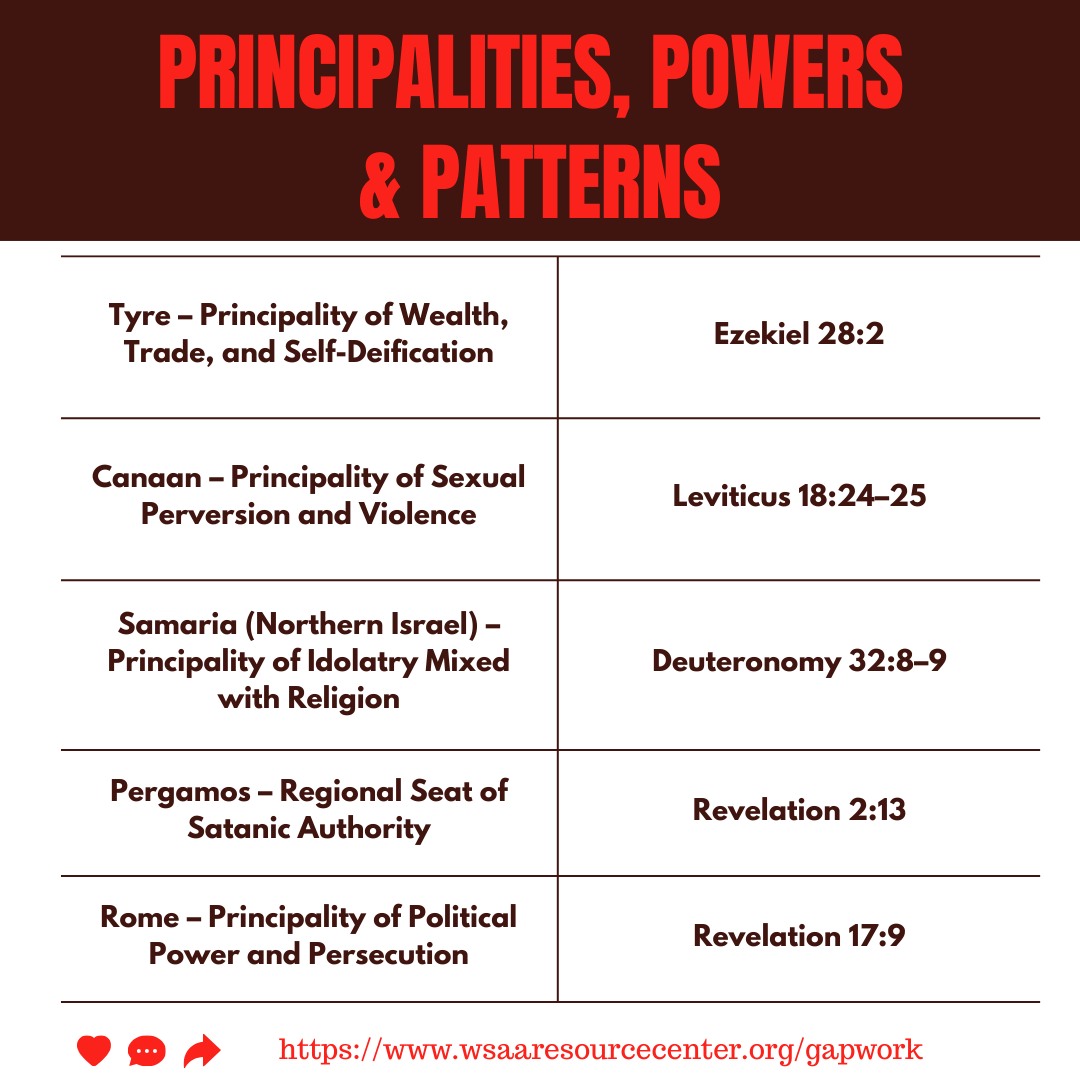
11. Tyre – Principality of Wealth, Trade, and Self-Deification
Ezekiel 28:2
“Son of man, say unto the prince of Tyrus, Thus saith the Lord GOD; Because thine heart is lifted up, and thou hast said, I am a God, I sit in the seat of God, in the midst of the seas; yet thou art a man, and not God, though thou set thine heart as the heart of God.”
Though addressing a human ruler, the language reveals a spiritual power behind Tyre’s commercial empire, where wealth and trade produced godlike self-sufficiency a classic economic principality.
12. Canaan – Principality of Sexual Perversion and Violence
Leviticus 18:24–25
“Defile not ye yourselves in any of these things: for in all these the nations are defiled which I cast out before you: And the land is defiled: therefore I do visit the iniquity thereof upon it, and the land itself vomiteth out her inhabitants.”
Canaan’s sins are described as defiling the land itself, indicating a territorial spiritual corruption so severe that God judges the region as a whole, not isolated individuals.
13. Samaria (Northern Israel) – Principality of Idolatry Mixed with Religion
2 Kings 17:29–30
“Howbeit every nation made gods of their own, and put them in the houses of the high places which the Samaritans had made, every nation in their cities wherein they dwelt.
And the men of Babylon made Succothbenoth, and the men of Cuth made Nergal, and the men of Hamath made Ashima.”
Samaria becomes a region of syncretism, blending worship of Yahweh with idols. This mixture reflects territorial deception rather than pure rebellion one of the most dangerous regional strongholds.
14. Pergamos – Regional Seat of Satanic Authority
Revelation 2:13
“I know thy works, and where thou dwellest, even where Satan’s seat is: and thou holdest fast my name, and hast not denied my faith, even in those days wherein Antipas was my faithful martyr, who was slain among you, where Satan dwelleth.”
Jesus Himself identifies Pergamos as a territorial center of satanic authority, likely tied to emperor worship and idolatry. This is one of the clearest New Testament affirmations of regional spiritual power.
15. Rome – Principality of Political Power and Persecution
Revelation 17:9
“And here is the mind which hath wisdom. The seven heads are seven mountains, on which the woman sitteth.”
Rome is symbolized as a spiritual-political system intoxicated with power and persecution. The principality operates through empire, law, and dominance rather than overt pagan ritual alone.
The Nations Deceived Collectively
Revelation 12:9
“And the great dragon was cast out, that old serpent, called the Devil, and Satan, which deceiveth the whole world: he was cast out into the earth, and his angels were cast out with him.”
This verse shows global territorial deception, where Satan and his angels influence nations through lies, systems, and collective thinking rather than constant individual possession.
Biblically, principalities over regions:
Influence empires, cultures, and cities
Operate through pride, idolatry, fear, and injustice
Are resisted by truth, obedience, and God’s sovereign action
Are ultimately defeated by Christ (Colossians 2:15)