Know Justice Know Peace
The Moment Jesus Revealed the Difference Between Protection and Power
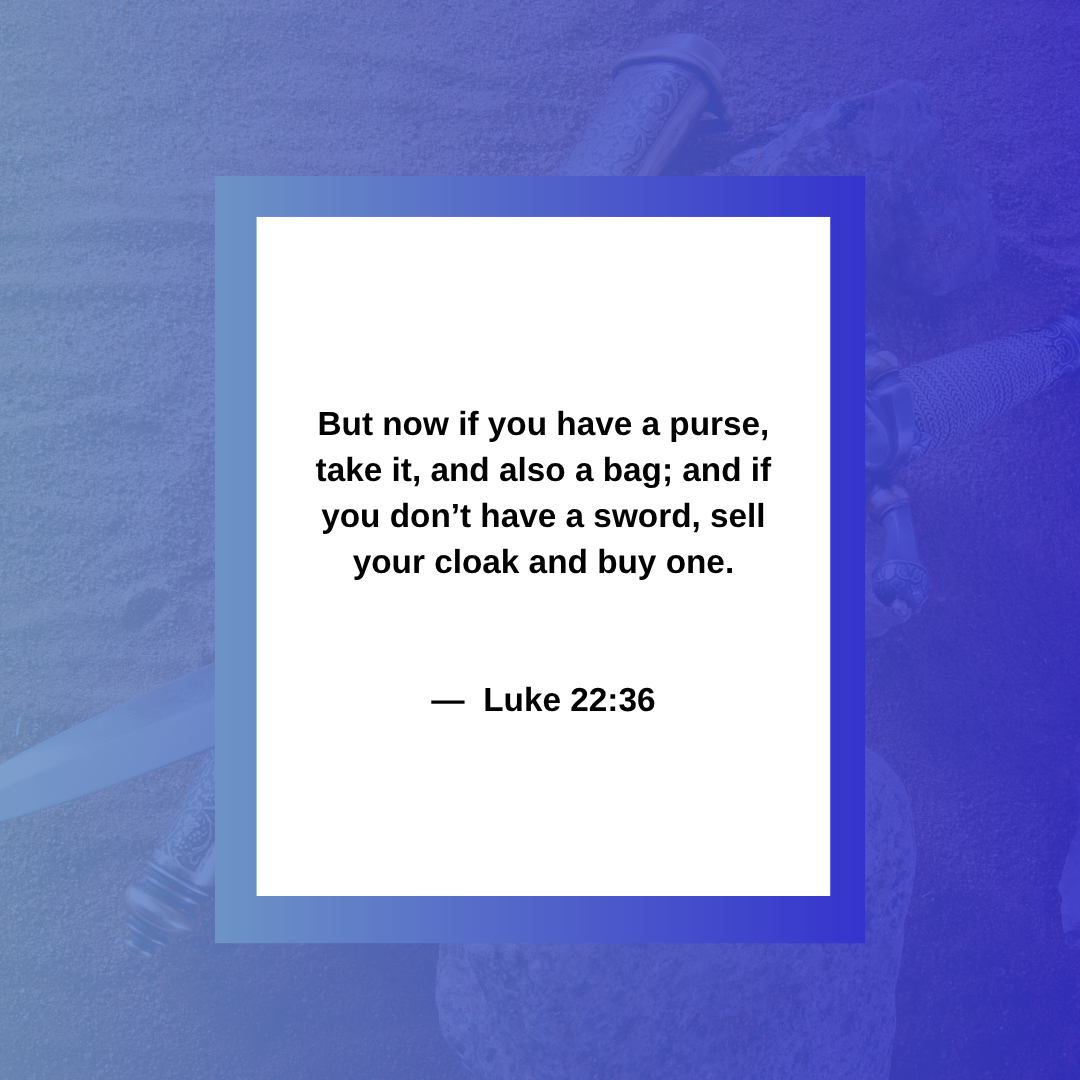
If Jesus said, "buy a sword," why did He immediately stop Peter from using one? Self-defense is not presented in Scripture as inherently sinful, yet neither is it the foundation of the Christian life. Jesus acknowledged that His disciples would enter a dangerous world where practical preparation had its place, but He also made it clear that God's redemptive plan could never be accomplished by human force. The sword could protect a traveler, but it could never save a soul. Knowing when to stand, when to endure, and when to surrender to God's greater purpose requires more than courage. It requires discernment, faith, and complete trust in the King whose Kingdom is not of this world.
The night Jesus was arrested, He said something that has confronted disciples for generations, “Sell your cloak and buy a sword.” At first glance, it sounds like a command to prepare for battle, but the story that follows reveals a deeper truth about the kind of kingdom Jesus came to establish.
Luke 22:36 is one of those passages that forces us to slow down, look closer, and ask better questions. Did Jesus suddenly change His message from peace to power? Did the Savior who taught people to love their enemies now want His followers to fight? Or is there something happening beneath the surface that reveals a greater spiritual reality? The answer is found in understanding the moment, the mission and the heart of Jesus.
Behind the Command
Only Luke records Jesus saying, “Sell your cloak and buy a sword.” That does not mean Matthew, Mark, and John disagreed with Luke. The four Gospels were not written as identical biographies. They are four inspired accounts that reveal different details about the life and ministry of Jesus.
Think of four people describing the same event. One may remember the conversation, another may focus on the actions, another may highlight the emotions, and another may emphasize what happened afterward. Different details do not automatically mean disagreement. They can reveal a fuller picture.
Luke had a specific purpose in writing the Gospel. He was a physician, described by Paul as the beloved physician in Colossians 4:14. He traveled with the apostle Paul during missionary journeys and became the author of both the Gospel of Luke and the book of Acts. Together, these writings provide a two-volume history of Jesus and the early Church. Luke explained his purpose at the beginning of his Gospel, “Since many have undertaken to compile a narrative... I too decided... to write an orderly account... so that you may know the certainty of the things you have been taught,” Luke 1:1-4. Because Luke was focused on showing the movement from Jesus’ earthly ministry to the mission of the Church, he included details that highlighted the transition the disciples were about to experience.
The Mission That Was Changing
Earlier in Jesus’ ministry, He sent His disciples out with instructions that emphasized complete dependence on God. In Luke 9 and Luke 10, the disciples were told to travel without extra supplies. They carried no moneybag, no extra clothing, and no additional resources. God would provide through His people. But now the moment is changing. Jesus tells them: “Take a purse. Take a bag. Buy a sword.” Why?
Because the disciples were entering a new season. Jesus was about to leave them physically. The days ahead would include rejection, hardship, persecution, and danger. The instruction was not about launching a violent movement. It was about recognizing a difficult reality. Following Jesus would not always be comfortable or accepted by the world. The disciples needed preparation, wisdom, and awareness. However, Luke immediately shows what Jesus did not intend the sword to become.
When Judas arrived with the crowd to arrest Jesus, Peter used a sword and cut off the ear of the high priest’s servant. Jesus responded: “No more of this,” Luke 22:51. Then Jesus healed the man.
This moment is extremely important. Jesus did not allow His followers to use weapons to stop His arrest because His arrest was not a failure of God’s plan. It was part of God’s plan. Peter saw the situation through human eyes. He wanted to protect Jesus from suffering. Jesus saw the eternal purpose of the Father. The sword was never meant to become the tool for advancing God’s kingdom.
The Heart Before the Hands
The central question is not simply, “Did Jesus tell them to carry swords?” The deeper question is, “What kind of kingdom was Jesus building?” Jesus did not come to establish a kingdom through force, fear, or political control. He came to transform hearts. Peter wanted to change the circumstances around him. Jesus wanted to change the world from the inside out. This is the difference between worldly thinking and Kingdom thinking.
Worldly thinking says power comes from control, dominance, and winning every battle. Kingdom thinking says true victory comes through surrender, faithfulness, love, and obedience to God. Jesus made this clear when He said, “My kingdom is not of this world. If my kingdom were of this world, my servants would have been fighting...” John 18:36. Jesus never instructed His followers to spread the gospel through violence. The Kingdom of God would not advance because people were forced to believe. It would advance because lives were transformed by grace.
The Battle Behind the Battle
The Bible does not ignore conflict. Scripture recognizes that people face danger, injustice, suffering, and evil. But the New Testament reveals that the deepest battle is not fought with physical weapons. For our struggle is not against flesh and blood, but against the rulers, against the authorities, against the powers of this dark world and against the spiritual forces of evil in the heavenly realms, Ephesians 6:12.
The enemy is not ultimately another person. The deepest enemy is sin, deception, hatred, and spiritual darkness. That is why Paul describes the armor of God in Ephesians 6:10-18. The weapons of the believer are truth, righteousness, faith, salvation, the Word of God, and prayer.
The Kingdom of God is not built by conquering people. It is built by loving people, serving people, and pointing people to Jesus.
The Sword and the Savior
To understand Luke 22:36, it helps to understand the cultural setting. The word often translated as “sword” refers to a short sword called a machaira. In first-century Judea, this type of sword could serve practical purposes. Travelers might carry one for protection against robbers or wild animals. It could also be used as an everyday tool. The Roman Empire controlled Judea and did not allow private armies or revolutionary groups to operate freely. Yet ordinary items that could serve multiple purposes were not unusual.
However, carrying swords during Passover was politically sensitive. Jerusalem was crowded, Roman authorities were watching carefully, and many Jews were hoping for a Messiah who would overthrow Rome through military power. Some of Jesus’ disciples likely misunderstood His words through that political atmosphere. They expected a conquering king who would defeat earthly enemies.
But Jesus came first as the suffering Savior described in Isaiah 53. The crown He received was not a crown of gold but a crown of thorns. The victory He won was not through killing His enemies but by giving His life for them.
A Faith That Faces Fear
Modern life still creates moments where people feel threatened. Fear can come through cultural conflict, personal struggles, broken relationships, uncertainty, injustice or anxiety about the future. Our natural response is often to protect ourselves at all costs. We want to control outcomes, defeat opponents, and secure our own safety. But Jesus calls His followers to a different way.
A sword may protect a person’s body, but only God can transform a person’s heart. A person can win an argument and still lose compassion. A person can defeat an enemy and still be defeated by bitterness. A person can gain influence and still lose peace.
The Kingdom of God operates differently. A simple way to picture it is this: A locked door can keep someone outside. But only a changed heart can turn an enemy into a neighbor. Real peace is not created by ignoring injustice. Biblical peace is connected to God’s righteousness and truth.
Jesus cared deeply about justice. He defended the vulnerable, confronted hypocrisy and welcomed those society rejected. But His method was different from earthly kingdoms. He did not conquer through armies. He conquered through the cross. He did not defeat evil by becoming more violent than evil. He defeated evil by absorbing its power and rising again. The resurrection declared that sin, death and darkness would not have the final word.
The Kingdom That Changes Everything
Luke 22:36 reminds us that following Jesus requires wisdom. It requires understanding the difference between preparation and aggression, protection and revenge, justice and hatred. Jesus acknowledged that His disciples would face hardship. He did not promise an easy road. But He also showed them that their ultimate hope was never found in human strength. The world often measures power by what can be controlled. Jesus measures power by what can be transformed.
The greatest victories of the Kingdom happen when forgiveness replaces bitterness, faith replaces fear, humility replaces pride, and love replaces hatred. The question Jesus leaves us with is not simply what weapon we carry in our hands. It is what condition exists in our hearts.
The same Jesus who told His disciples to prepare for a difficult road also healed the wounded man Peter attacked. The same Jesus who faced injustice chose forgiveness. The same Jesus who had all power chose the cross. That is the King we follow. His Kingdom is not built by force. It is built by transformed lives. And the peace He gives is not dependent on circumstances around us, but on the presence of Christ within us.