Claiming the Kingdom
What is worth everything to you? What would you trade your entire life to possess? At the resurrection of Jesus, the answer breaks through the grave, revealing a Kingdom where life conquers death and eternity outweighs everything temporary.
Jesus paid it all through the cross and confirmed it through the empty tomb, securing what we could never earn. Yet there is still a cost to claiming the Kingdom, because receiving it requires surrender, not currency. A surrendered heart that believes in Jesus and yields fully to Him. You do not purchase it with works, you enter it by trusting His finished work and allowing His love to transform everything you are. You do not pay for it with works, but you step into it by laying down everything that competes with the One who already paid the price.
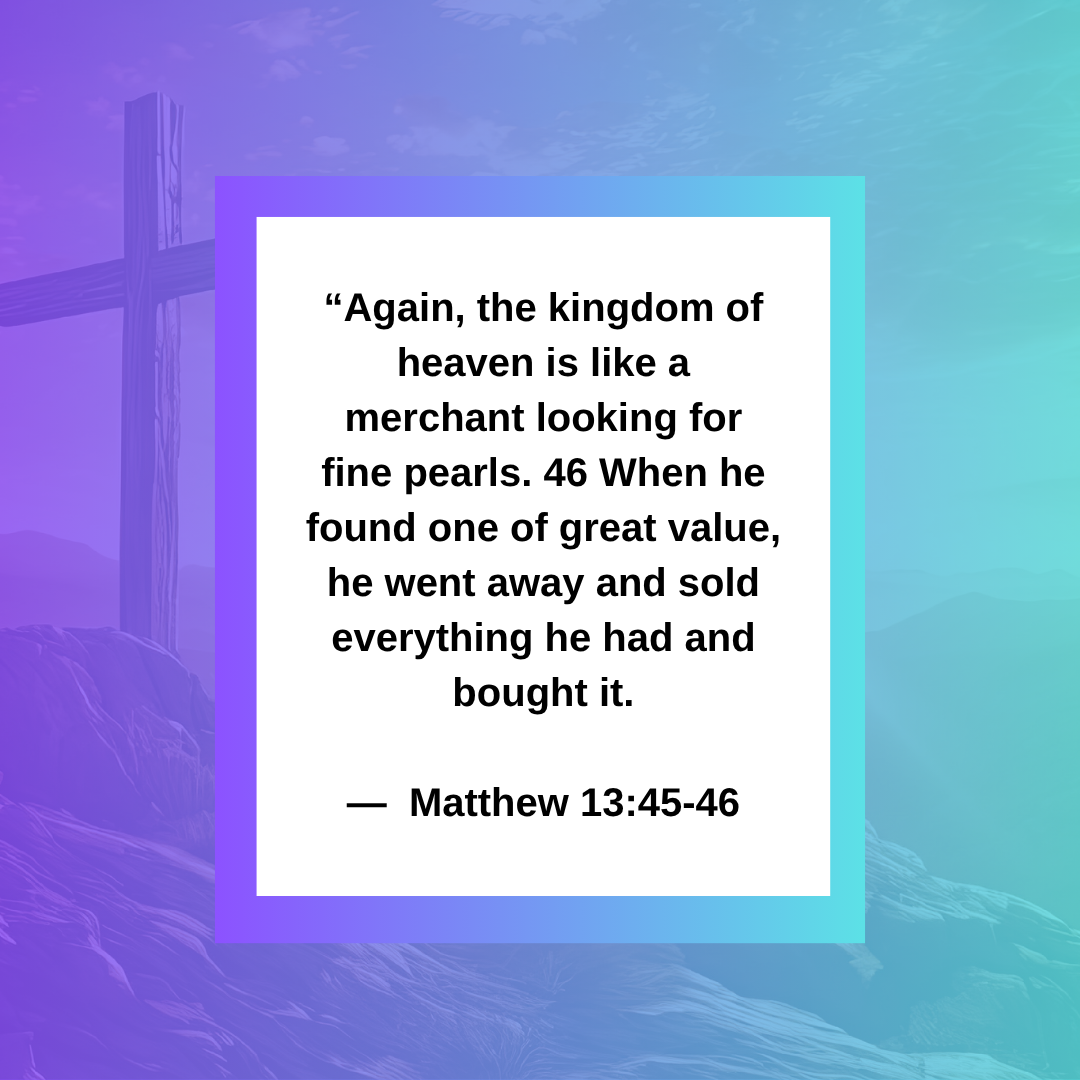
In Matthew 13, Jesus gathers a series of parables to reveal the mystery of the Kingdom of Heaven. It begins small like a mustard seed yet grows beyond expectation. It works quietly like yeast in dough. It coexists with evil like wheat among weeds until judgment. Its value surpasses all earthly worth like hidden treasure and a costly pearl. He shows that not everyone will perceive its truth because understanding requires both spiritual hunger and receptive hearts. The chapter moves from public teaching to private explanation, emphasizing that revelation is given to those willing to seek deeper. Each story layers insight, illustrating both the accessibility and the exclusivity of the Kingdom, near to all yet embraced by few. Ultimately, it concludes with a sobering reminder that the Kingdom demands discernment because a final separation is coming between what is righteous and what is not.
The Parable of the Pearl of Great Price in Matthew 13:45–46 is sharp, and spiritually piercing, just two verses yet eternally weighty. Jesus describes a merchant, a man experienced in searching for valuable pearls, who upon finding one pearl of immense worth sells everything he owns to obtain it. Unlike the man in the previous parable who stumbles upon hidden treasure unexpectedly, this merchant is actively seeking. He knows value when he sees it, and when he encounters something that surpasses all comparisons, he responds with radical surrender. There is no hesitation, no bargaining, no divided loyalty, just decisive devotion.
This parable speaks directly into a culture obsessed with accumulation, identity, and curated worth. The merchant represents the soul that has explored options such as careers, relationships, success metrics, and self expression, yet still senses that something ultimate is missing. He is not ignorant, he is informed. He has seen many pearls, many things of beauty and promise, but none like this one. When he finds it, everything else loses its grip. This is not reckless abandonment, it is awakened awareness. He does not lose everything, he exchanges lesser things for the greatest thing.
The pearl itself represents the Kingdom of Heaven, life under the reign of God, relationship with Christ, eternal truth that transcends temporary satisfaction. What makes this image powerful is that pearls are formed through irritation within oysters. A grain of sand enters, and over time, through pressure and persistence, it becomes something precious. There is a subtle implication here. What is most valuable in the Kingdom is not always born in comfort but often through tension, surrender, and transformation. The beauty of the pearl is the result of a process, just as the beauty of a surrendered life is shaped through refinement.
It will cost you everything, but it will be worth more than anything.
Position matters in Scripture, and this parable is strategically placed between the Parable of the Hidden Treasure and the Parable of the Dragnet. This is not accidental, it forms a spiritual progression. The Hidden Treasure tells of a man who discovers value unexpectedly and gives up everything to secure it. The Pearl of Great Price shifts the lens to someone who is intentionally searching and still arrives at the same conclusion, total surrender is required. Whether you stumble upon truth or seek it relentlessly, the response is the same. It will cost you everything, but it will be worth more than anything.
Then comes the Dragnet, a parable of separation, where fish of every kind are gathered and later sorted, the good kept and the bad discarded. This adds urgency and weight to the previous two parables. The treasure and the pearl invite you to recognize value and respond with surrender, but the dragnet reminds you that time is not indefinite. There will be a moment of reckoning. The Kingdom is not merely a philosophical idea to admire, it is a reality that demands a decision.
Together, these three parables form a powerful triad, discovery, decision, and destiny. The treasure shows that the Kingdom can interrupt your life unexpectedly. The pearl shows that even the most intentional search culminates in the same radical call. The dragnet reveals that ignoring or delaying that call has eternal consequences. This structure speaks with clarity into modern life, where options are endless and commitment is often delayed. It confronts the illusion that you can keep everything and still gain what matters most.
For a generation navigating identity, purpose, and value in a world saturated with noise, the Pearl of Great Price cuts through with stunning simplicity. It asks a question that cannot be avoided. What is worth everything to you. Not what you admire, not what you follow casually, but what you would trade your entire life for. The merchant’s answer is immediate. When he finds what is truly valuable, everything else becomes expendable.
There is also a challenge here to redefine success. The merchant is not portrayed as foolish for selling all he has, he is portrayed as wise. In a culture where success is measured by accumulation, Jesus reframes it as discernment, knowing what is ultimately valuable and aligning your life accordingly. The Kingdom is not an addition to your life, it is the reordering of your life.
The beauty of this parable is that it does not glorify loss, it glorifies exchange. The merchant is not left empty, he is left fulfilled. He trades many lesser pearls for one incomparable treasure. This is the invitation of the Kingdom, not to diminish your life, but to anchor it in something eternal.
The Pearl of Great Price is not just about what you give up, it is about what you finally see clearly. When your vision is sharpened and your heart awakened, surrender stops feeling like sacrifice and starts looking like wisdom. And in that moment, like the merchant, you will not need to be convinced, you will simply respond.