The Toxic Culture of Spiritual Narcissism: How to Recognize, Recover and Heal
Unhealthy relational and leadership patterns do not discriminate by location. They can emerge in churches, homes, workplaces, and community settings wherever power is misused, accountability is lacking, and the needs of others are consistently disregarded. While not every disagreement, conflict, or leadership mistake is evidence of narcissism or abuse, persistent patterns of manipulation, control, blame-shifting, and emotional intimidation can cause significant harm to individuals and communities.
Church hurt refers to the emotional, spiritual, or psychological trauma that results from painful experiences within a religious community or through the actions of spiritual leaders. It may stem from spiritual abuse, toxic church cultures, leadership manipulation, betrayal of trust, or the misuse of biblical authority. This type of pain often cuts especially deep because it occurs in a place where people expect to find safety, healing, truth, and spiritual support. When the source of harm is connected to one's faith community, the resulting confusion can affect not only relationships but also a person's trust in God, themselves, and others.
Rather than reflecting the humility, servanthood, and Christ-centered leadership modeled in Scripture, spiritual narcissism elevates image, influence, and personal power above the well-being of God's people.
In some church environments, narcissistic traits can take the form of what is often called spiritual narcissism. This occurs when faith, biblical language, spiritual authority, or ministry positions are used to conceal personal flaws, seek admiration, maintain control, avoid accountability, or manipulate others. Rather than reflecting the humility, servanthood, and Christ-centered leadership modeled in Scripture, spiritual narcissism elevates image, influence, and personal power above the well-being of God's people.
Scripture consistently teaches that healthy leadership is marked by humility, integrity, accountability, compassion, and a willingness to serve rather than dominate. Jesus taught that those entrusted with leadership should not lord authority over others but should serve faithfully and sacrificially. When leadership or relationships consistently produce fear, confusion, coercion, shame or dependence on a person rather than growth in Christ, it is wise to carefully examine those patterns.
Jesus warned, "Beware of false prophets, who come to you in sheep's clothing, but inwardly they are ravenous wolves," Matthew 7:15. Wolves often appear spiritual on the outside while producing unhealthy fruit beneath the surface.
The following examples and warning signs are intended to help identify unhealthy behaviors that may appear in church, home, work, or community environments. Their purpose is not to encourage suspicion or judgment, but to promote discernment, truth, healing, and healthy relationships grounded in both biblical wisdom and emotional well-being.
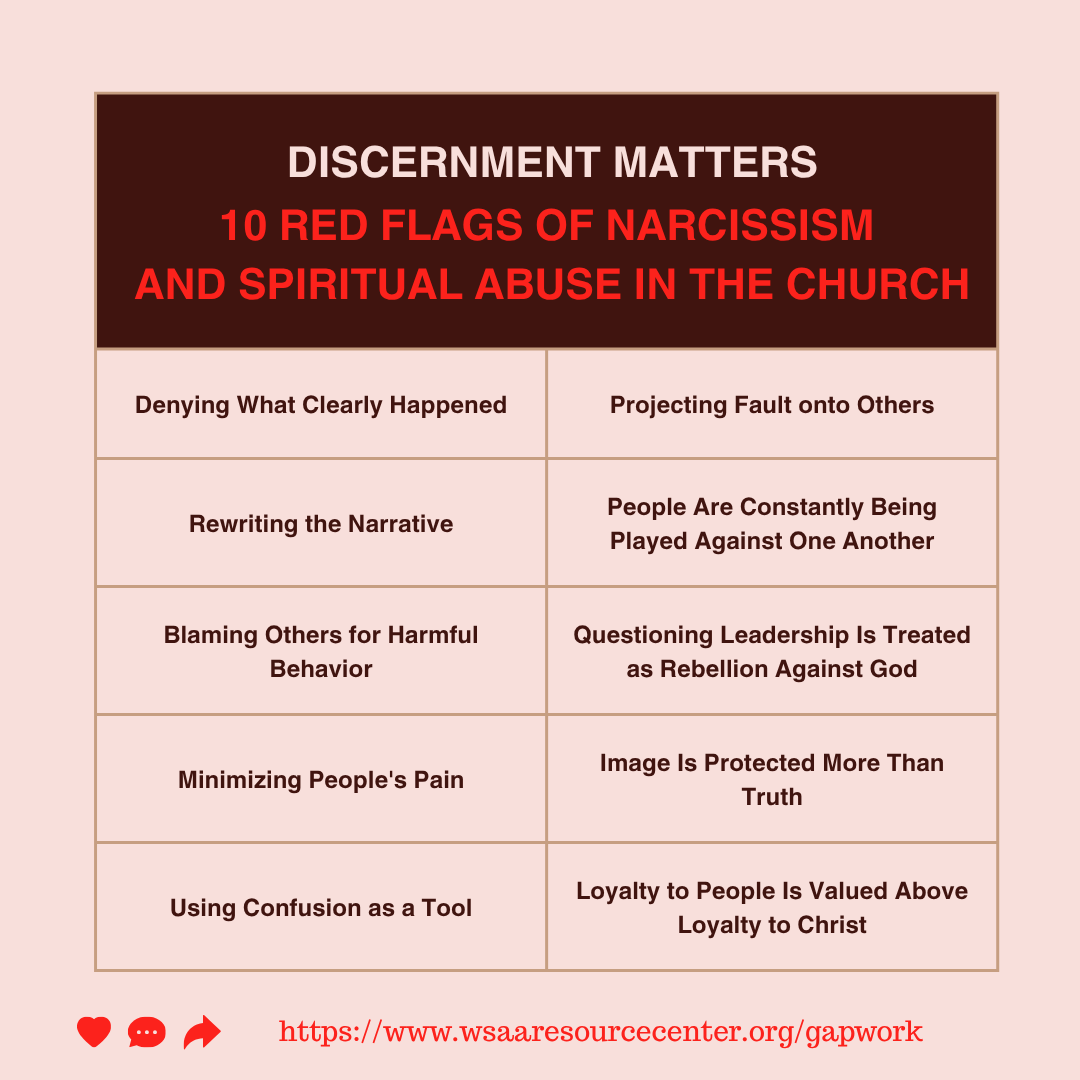
1. Denying What Clearly Happened
When concerns are raised, conversations, promises, or actions may be denied altogether. You may hear statements such as, "That never happened," or "You misunderstood." Over time, members begin questioning their own memories and experiences.
2. Rewriting the Narrative
Events are retold in ways that protect certain individuals or preserve an image. Facts may be selectively presented, and legitimate concerns are reframed as rebellion, misunderstanding, or a lack of spiritual maturity.
3. Blaming Others for Harmful Behavior
Instead of taking responsibility, fault is shifted to those who were hurt. Members may be told they are the reason for conflict because they asked questions, set boundaries, or expressed concerns.
4. Minimizing People's Pain
Valid hurts and concerns are dismissed with statements like, "You're being too sensitive," "Just pray about it," or "You need to let it go." This can make people feel that their experiences do not matter.
5. Using Confusion as a Tool
Expectations constantly change. What was encouraged yesterday is criticized today. Policies, standards, or teachings may seem inconsistent, leaving members dependent on leadership to determine what is acceptable.
6. Projecting Fault onto Others
Those displaying unhealthy behavior accuse others of the very things they are doing. People who seek accountability may be labeled divisive, controlling, prideful, or manipulative to divert attention from the real issue.
7. People Are Constantly Being Played Against One Another
When leaders or influential individuals regularly create division, share selective information, or pit members against each other, it produces confusion and distrust. God calls leaders to unity, not manipulation. "A perverse man sows strife, and a whisperer separates the best of friends," Proverbs 16:28.
8. Questioning Leadership Is Treated as Rebellion Against God
Healthy leaders welcome accountability and examination. Unhealthy environments often equate questioning people with questioning God. Yet the Bereans were commended because they tested what they were taught against Scripture. "They received the word with all readiness, and searched the Scriptures daily to find out whether these things were so," Acts 17:11.
9. Image Is Protected More Than Truth
When preserving reputations becomes more important than honesty, repentance, and accountability, spiritual danger exists. Scripture teaches that truth should never be sacrificed for appearances. "Therefore, putting away lying, 'Let each one of you speak truth with his neighbor'," Ephesians 4:25.
10. Loyalty to People Is Valued Above Loyalty to Christ
A major warning sign is when devotion to a leader, ministry, or movement becomes more important than obedience to Jesus. True spiritual leadership points people toward Christ, not dependence upon personalities. "For there is one God and one Mediator between God and men, the Man Christ Jesus," 1 Timothy 2:5, NKJV.
The ultimate test is fruit. Jesus said, "Therefore by their fruits you will know them," Matthew 7:20. Healthy churches produce freedom, truth, humility, repentance, and spiritual growth. Wolves may wear sheep's clothing, but eventually the fruit reveals the root.
A Healthy Church Environment
A healthy church welcomes accountability, values truth, admits mistakes, honors questions, and encourages believers to grow in their relationship with God rather than dependence on any one person.
Recovering from an Unhealthy Church Environment, Toxic Culture and Spiritual Manipulation
Leaving an unhealthy church environment can feel like recovering from a deep wound. When spiritual authority is misused, biblical truth is distorted the damage can affect your trust in leadership, community, and even your relationship with God.
The first step in recovery is understanding that God never intended His people to be controlled through fear. "For God has not given us a spirit of fear, but of power and of love and of a sound mind," 2 Timothy 1:7. Any culture that consistently uses fear, shame, threats, or manipulation to maintain authority is operating contrary to the character of Christ. Narcissistic and controlling environments often create confusion, self-doubt, guilt, and fear. Recovery requires intentionally replacing distorted messages with God's truth. "And do not be conformed to this world, but be transformed by the renewing of your mind," Romans 12:2. As your mind is renewed through Scripture, prayer, and healthy counsel, your confidence in God's voice and your ability to discern truth begins to return. Do not be afraid to trust wise counsel, especially from mature, grounded believers who demonstrate humility and spiritual discernment.
Second, separate God from the people who misrepresented Him. Human leaders can fail, but God's nature remains unchanged. "Jesus Christ is the same yesterday, today, and forever," Hebrews 13:8. Your disappointment with people does not change God's faithfulness. One of the greatest wounds caused by spiritual manipulation is confusing the actions of people with the character of God. Healing begins when you return to Scripture and allow God to reveal Himself apart from the unhealthy experiences you endured. "Jesus Christ is the same yesterday, today, and forever," Hebrews 13:8. People may have misrepresented Him, but His nature remains faithful, loving, and true.
Third, reclaim your God-given ability to discern. The Word of God commends believers for examining what we are taught rather than accepting everything blindly. "These were more fair-minded than those in Thessalonica, in that they received the word with all readiness, and searched the Scriptures daily to find out whether these things were so," Acts 17:11. Return daily to Scripture to re-anchor your thoughts in truth rather than emotional confusion. Pray for clarity, peace, and the ability to forgive without reopening yourself to harm.
Fourth, understand that the power of God was never given to exalt personalities. The Holy Spirit points people to Christ, not to human dependency. "But the anointing which you have received from Him abides in you," 1 John 2:27. It is important to discern what is the anointing and what is not. The annointing is God’s enabling power. Spiritual leaders should equip believers to hear God, not convince them that access to God comes only through them.
Finally, forgive and allow yourself time to heal. Healthy spiritual recovery involves prayer, Scripture, wise counsel, and reconnecting with believers who demonstrate humility, accountability, and genuine love. Remember, Christ came to set people free, not place them in spiritual bondage. "Therefore if the Son makes you free, you shall be free indeed," John 8:36. God never intended believers to walk alone, but He also never intended them to remain in harmful environments. Jesus often withdrew from unhealthy opposition while continuing His mission. Healthy healing includes establishing wise boundaries, seeking mature believers who demonstrate humility and accountability, and allowing trust to be rebuilt over time. "Above all else, guard your heart, for everything you do flows from it," Proverbs 4:23. Surround yourself with spiritually mature, safe counsel that confirms God’s character, not control or fear.
Healing is possible. The goal is not merely leaving an unhealthy church culture, it is rediscovering the freedom, truth, and relationship with God and those that love God and people. Practice obedience to God’s voice over human pressure, even when it requires separation or distance for healing.
"He restores my soul; He leads me in the paths of righteousness for His name's sake," Psalm 23:3.
In scripture, David's recovery from Saul's attacks did not come from proving himself to Saul it came from remaining rooted in God. Likewise, your healing will not come from getting everyone to understand your experience. It comes from rediscovering your identity in Christ, renewing your mind with truth, and allowing the Good Shepherd to restore your soul. God leads and restores YOU in a way that protects His holy character, faithfulness, and reputation. It is about God acting consistently with who He is, both loving and righteous at the same time.
Click here to read: A Christian's Checklist to Recognizing Narcissistic & Spiritual Abuse